
The someone Pavie predicted would come was Roland Meyer.
On the evening of 14 February 1925, on the plateau far above Kampot, the Bokor Palace Hotel opened with a party. Guests motored up the newly built road to the summit. There was a revue in the grand hall, then fireworks and a torchlit procession, and the ball ran until Sunday morning. On the terrace, guests watched the sun set over the Gulf and compared the view to Capri.
Meyer was not there. He was in Laos, barred by the French administration from the country he loved.
It was from Laos, in 1930, that Meyer published a book: Komlah, visions d’Asie. His memoir of Southeast Asia is the fullest version of the beginnings of the Bokor project. In it, he tells his version of the story: that before Bokor was a colonial resort, it had been his obsession. It is his account of how he became enamoured of the mountain, how he promoted it for years, and how his dream was taken from him.
Meyer wasn’t like other colonists. He hadn’t come to Cambodia driven by duty or ambition. He came because he was infatuated.

At seventeen, he watched the Cambodian Royal Ballet perform at the 1906 Marseille Colonial Exhibition. It was the troupe’s first performance outside Cambodia, and both he and the crowd were overwhelmed. In his own words, that evening decided his fate.
Within a year he had used his father’s diplomatic connections to secure a colonial-administration internship, and in December 1907 he arrived in Indochina: eighteen years old, a junior clerk in the Governor-General’s cabinet.
He immersed himself in Khmer culture and mastered the language. Rather than living in Phnom Penh, he moved to the Khmer village of Prek Thmey. Other Frenchmen referred to him dismissively as an indigénophile, one who had ‘gone native.’
Meyer was a romantic, and he wrote constantly about his love for Cambodia and its people. His memoir reads like a novel: he cast himself as its hero, a young Frenchman called “Komlah,” the Bachelor, and wrote about his own life in the third person:
…the elegiac songs of the daughters of Kampuchea; these nostalgic accents draw him irresistibly toward the shade of the mango trees and palms that weave, along the enchanted banks… Komlah wants to know the life of this people, the villages with their leaf houses perched high on their stilts, the shaded monasteries and the pagodas with their glittering roofs, and he is conquered body and soul by this existence worthy of the first ages of humanity.
He learned of the mountain from the Cambodians he lived among. “You had to hear them describe its unexplored sites, its mysterious caves, the refuges of hermits… its great cats, elephants, rhinoceros, and the anthropoid apes called ‘men of the woods,’” he wrote. “The tales told at evening gatherings in the huts of the bush never ran dry.”
By his own account, only one Frenchman had written of the mountain before him: “Pavie alone briefly mentions the existence of the mountain of Popokvil and the legendary tales that circulate about it.” Pavie had mentioned it in passing. In Meyer’s hands it became magnificent. In his telling, even the rocks of Popokvil looked like the ruins of Angkor:
Popokvil! It was the inaccessible summit of the great chain of Phnom Kamchay, the mountain par excellence, as famed in Cambodia as Mount Fuji in Japan… the chaotic landscapes, the summits crumbled into blocks of friable sandstone, comparable to the ruins of Angkor, the high bare moors scattered with alignments of rocks, swept by the sea wind, and the aerial lakes, peopled with strange fish and covered with a treacherous carpet of immense water lilies!
In other passages he compared the mountain to the Atlas, the Andes, Ethiopia, Tibet, Tam Dao, Fontainebleau, the Egyptian pyramids, and France itself.
For years the obsession was his alone. Then in 1911, passing through Kampot, he met the first Frenchman who could vouch for what his Cambodian informants had told him. Dr Pannetier, a doctor resident at Kampot, had pushed into the Cardamom hinterland behind the coast. Pannetier “corroborated and generously sharpened our documentary file,” Meyer wrote, “and instilled in us once and for all the great idea of the future sanatorium of Popokvil.”
But Meyer could find little interest elsewhere. He wrote that the idea met ten years of “ignorance” and “general indifference.” He specifically denounced the Kampot authorities for neglecting “the most captivating problem of their province,” and no one listened.
His file grew anyway: Cambodian testimony, his own investigations, “a hundred sketches, profiles and plans of the chain” taken from every point in Cambodia where Phnom Kamchay was even faintly visible. He deposited it all with the Cadastre, the colony’s land-survey service, where one official took him seriously: a surveyor named Jubin. Meyer admits that for years his work “interested only the Cadastre service, and the very name of Popokvil remained unknown.”
Then, in February 1917, Pierre Lefèvre-Pontalis, the French minister at Bangkok, came through Cambodia by the new route of Kampot and Kèp, promoting a future for the neglected southwest coast: access to Siam, the Gulf islands, and above all a deep-water port at Réam.
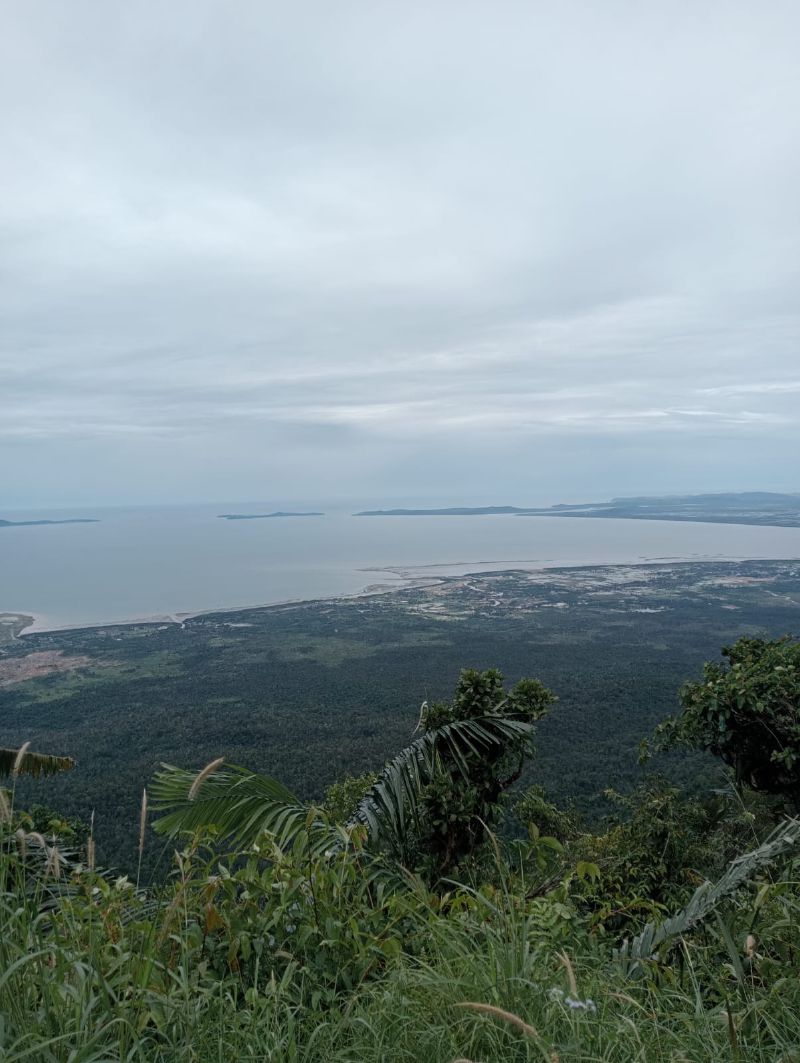
Meyer joined the minister’s Gulf cruise, and saw the mountain from the sea for the first time. While Lefèvre-Pontalis made the case for Réam, Meyer stood on deck sketching the south and west faces of the Elephant Mountains as they rose out of the water. Watching the wall of cliffs and forest stretch along the coast like the Cévennes, the old frustration welled up again: “To live in this equatorial setting without suffering its rigors… to possess up there, on these plateaus of Popokvil, a little France at one’s door, and not to profit from it, was it not the height of aberration?”
He foresaw, he claimed, “the exact site of the culminating terrace where the future altitude station should rise.” He had marked, from the deck of a ship, the ground where his “city of the clouds” would stand. And it was there, eight years later, just as he’d foreseen, that the guests would dance into the morning, without him.
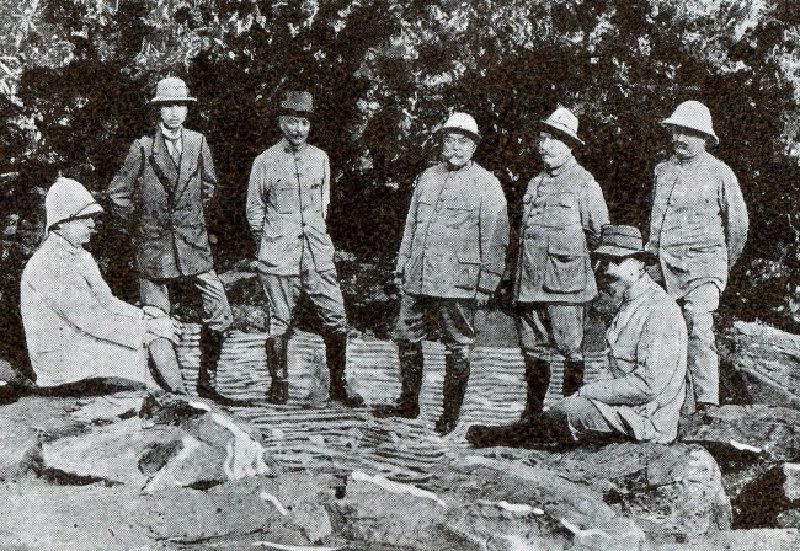
That, at least, is how Meyer tells it. The colonial record differs. He surfaces only twice, and neither time as the mountain’s champion: once in a group photograph, labeled the head of Political and Indigenous Affairs, and once as the secretary of a commission for the mountain, a meeting he was unable to attend.
The administration would eventually find its own reasons to be interested in the mountain. The war in Europe would cut the colony’s officials off from their home leaves, and a cold plateau within reach of Phnom Penh was no longer a romantic’s daydream; it was government business.
When the official account of the exploration was published in 1919, the credit went not to Meyer but to the “enlightened initiative” of the Resident Superior. The project was handed over to more senior, more practical men. And practical men had no use for a young romantic indigénophile.

That same year, Meyer published Saramani, danseuse khmèr, a novel that was at once a love letter to Cambodia and a scathing attack on the colonial society that governed it. The book made enemies of nearly everyone who mattered in Phnom Penh, from the colonial administration to the royal palace. Albert Sarraut, the Minister of Colonies in Paris, ordered that he be sent to Laos.
The love letter to Cambodia cost him Cambodia, and with it the mountain he had spent years trying to promote.
Making his dream a reality would fall to other men.
One of them was the very Kampot authority whose indifference had so enraged him.
Pour aller plus loin
The Man Who Built Kampot
Armand Rousseau treated a backwater posting as his life's work, rebuilding Kampot into the town that still stands. For years he ignored the romantic who kept depositing plans for a mountain resort.
The History of Bokor Mountain
Before Bokor became a colonial hill station, it was a mountain of local names, warnings, and stories: visible from Kampot, but still outside the world the French thought they understood.
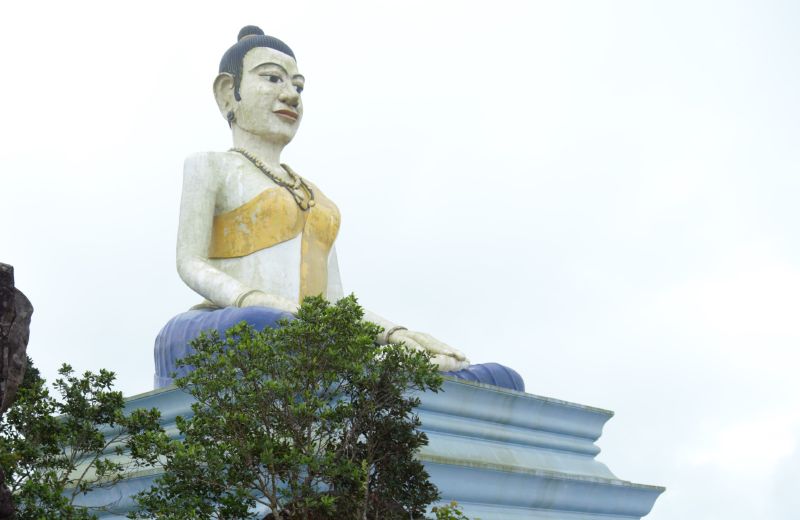
La Statue Géante du Mont Bokor : Qui Est Lok Yeay Mao ?
La statue géante du Mont Bokor porte un nom : Lok Yeay Mao, l'esprit gardien de Kampot. Ses légendes, ses sanctuaires, et pourquoi elle veille encore sur les voyageurs aujourd'hui.